Pages

Showing posts with label agricultural. Show all posts

Wednesday, August 8, 2007

Let's walk the talk

Okay, this so-called "BS Agricultural Engineering" course has ruined many engineering dreams, or at least, hinders career growth. Now what?

A few days ago I received an e-mail from one of the few readers of this blog. It says 'enough for the negative publicity about agricultural engineering'. What is important now is to know what to do. Hundreds of high school graduates will then be lured into this trap, fresh BSAE graduates are now spending considerable amount of money for their licensure exam this month, and even more old graduates, licensed on non-licensed, are now struggling for job that could at least gain them independence from parents and relatives. I have been trying to think of some options to address this issue. Here is a list of what I came up with:

1. Abolish Agricultural Engineering from all colleges and universities in the Philippines. This sounds like a summary execution but this is only an option.

2. Name change. I have worked with quite a number of engineers for 5 years and yet I have not met one who could understand thermodynamics and heat transfer better than agricultural engineers do. I have met electrical engineers who are good in engineering economics but, in general, not as good as agricultural engineers. I also suppose only agricultural engineers can explain "humidity" to a layman farmer. If you say you are an agricultural engineer, would anyone believe that you understand all these things?

3. Agricultural engineers should be allowed to take the licensure exams of other engineering degrees. This would be similar to the case of BS Agricultural Chemistry. Ag Chem is a 5-year course but their licensure exam is that of BS Chem, a 4-year course. For ag engs, maybe those who specialize in irrigation and drainage engineering or agricultural structures should be allowed to take the CE licensure exam, probably with the requirements of some additonal courses. For machinery majors, maybe a few more courses to make them eligible for the ME licensure exam, and so on and so forth. The results would be agricultural engineers with CE or ME license or licensed CE specialized in irrigation and drainage engineering or agricultural structures. Perhaps an ME specialized in agricultural machinery or processing. Just my wild thoughts.

4. Curriculum change. Maybe we should bring back the days when agricultural engineering was just one of the majors in BS Agriculture. Maybe the curriculum change could make the lives of agricultural engineering students reasonably easier. They should have better career chances as agriculturists rather than "improvised engineers".

These are only my wild thoughts. I know that there brainy and/or more experienced people out there who have better ideas. I would appreciate it very much if you could post your thoughts as comments or replies to this blog.
Thursday, August 2, 2007

5 years into the career trap


I am beginning to view agricultural engineering as a career trap; five years for the good ones, 6 on the average, while up to 10 years for the most devoted ones. :). Most students who took/are taking this degree are usually those who want to help this so-called agricultural country, improve the lives of our ever-poorest farmers, and are usually been exposed to the countryside environment at least once in their life. They are the ones who believe that farmers are still the backbone of the country, though not anymore it seems. They are the most adventurous and creative ones.

I remember when I was still a student I imagine myself driving an air conditioned and fully digital tractor with GPS tracking system. Sometimes even tilling a field with a remote controlled tractor or operating a fully automated piggery or livestock farm. Well, all these now belong to the IT guys, but I will have that in another story.

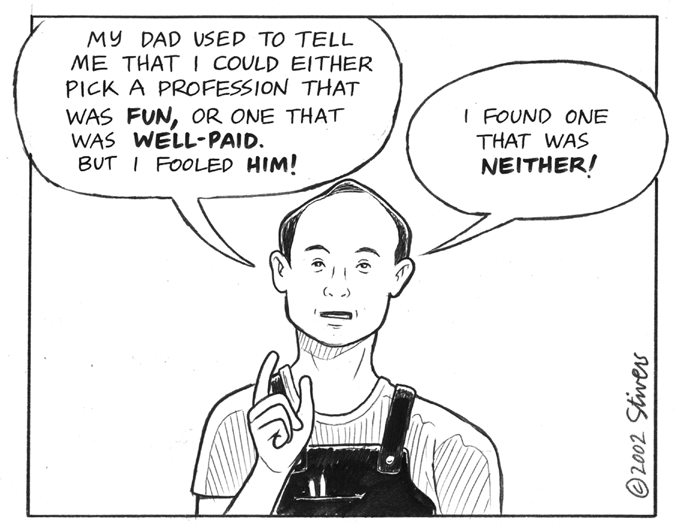
Where are we now? Stucked in the rut! Unemployed, discouraged workers giving up hope looking for job, new graduates in call centers, taking up other courses, machine operators working abroad, and many other sad stories. The most prestigious, I think, are those who have gone into teaching and research jobs. There are very few who are into engineering, though non-agricultural, but are paid way below their conterparts from other engineering fields.

Serving the country? Not realistic! One can not serve other people on an empty stomach. In my case, maybe I will practice agricultural engineering as a hobby later on, not as an income generating career.

I have worked with engineers from other fields, and, in my judgment, our advantage in terms of the use of engineering principles and knowledge is very much apparent. My problem is that I am trapped. Right now, my goal is to get off this career trap; maybe change my title, just the title.

Tuesday, July 31, 2007

Does it matter if you are licensed or not?

Based on my own experience, no. Based on other agricultural engineers' experiences, still no. It really does not matter if you have passed the board exam or not.

I only know three ways you can go after finishing your agricultural engineering degree. First, which is the most common, work as an employee (probably not as an engineer). Second, start your own business or till your father's farm. Thirdly, despair that you took agricultural engineering at all (because nobody wants to hire you as an engineer).

Are you expecting that the license of an agricultural engineer will have the same function as those of lawyers or civil engineers? Do you expect that you can sign and put your seal on engineering plans and designs after earning your agricultural engineering license? If you know one who has enjoyed his license this way, please introduce me to him/her.

Wednesday, July 25, 2007

Getting through the Challenges of Being an Agricultural Engineer

Ever since I entered the employment world, I really find my license as an Agricultural Engineer a hindrance towards landing a good job. Agricultural companies are not hiring agricultural engineers, they are hiring agriculturists. If ever they need engineers for their agricultural structures, they seek the help of civil engineers. For agricultural processing, they seek the services of chemical, mechanical, and electrical engineers, which is common in the feed milling industry. Well, there are companies hiring agricultural engineers, but only because they can get them at a lot lower salary than those of other engineers. In most cases, hired agricultural engineers are not given engineering jobs, or not even recognized as engineers at all, but as agriculturists - which they really are not, by educational background.


When I say I am an Agricultural Engineer, which I have not mentioned for quite a while now, people are most inclined to think of soil, crops, poultry, swine, and all those they consider as dirty jobs, which is only part of the whole story. They would then ask me "What are you doing in the city then?", without even asking me what Agricultural Engineering is all about. Too bad, I could not get the title "Licensed Agricultural Engineer" or just even the degree out of my resume. This 2 words in my resume have been preventing me from even being called to an interview.

Can an agricultural engineer do the job performed by "common" engineers? Well, it depends on how he puts his engineering knowledge into use. Based on experience, yes, and often times, even better, probably because agricultural engineers are usually challenged in the workplace and are prompted to prove what they can do. But the greatest problem he could face is how to get hired.

I finally landed on a job which I consider "not bad for an engineer whose greatest handicap is his title." "Sneak attack" seemed effective for me. I did not apply as an engineer. Instead, I applied as a technical writer and offered engineering economic analysis as an added skill. It seemed this is where most engineers are weakest, so I stole the job in a cloaked mode. They then gave me some lighting design jobs at first, and then some proofreading. Eventually they found out that I could do some engineering jobs too, I guess, and so they gave me assignments which I can call "real engineering job."

Truly, it all depends on how you put your assets into use.